Title: Dig, a dance in 21 parts
List of Images:
1. to the quick
2. archaeology
3. caryatids
4. pondering the circle
5. signatures: Wendy, Lisa, Lesli, Jessica, Rosa
6. finding
7. cutting off
8. prancing vase
9. koroi/Isadoras
10. signatures: Sarah, Nicole
11. wind and wrists
12. in pieces
13. line of tears
14. six columns
15. signatures: Benedette, Anita, Cary, Lisa
16. piecing together
17. second prancing vase
18. finding
19. offering
20. vase
21. gathering
Premiere: February 1991,University Dance Company, Power Center, Ann Arbor, MI. Subsequently performed at the UM Betty Pease Studio Theater, Ann Arbor, MI.
Dancers:
Thursday, Saturday:
Anne-Marie Acchione, Sarah Blackburn, Lisa Catrett, Anita Cheng
Rosa Huang, Wendy Light, Jessica Shinn
Friday, Sunday: Anne-Marie Acchione, Lisa Catrett, Anita Cheng, Lisa Darby, Wendy Light, Cary McWilliam, Benedette Palazzola
Special thanks to dancers Leslie Cohen and Nicole Meyer for their contribution to the rehearsal process.
Music: The Continuing Story of Counterpoint, Part Nine, by David Borden
Musicians:
Stephen Rush, synthesizers
James McLeod, bass clarinet
Louise Mygatt Lerdahl, soprano
Costume design: Ann Kessler
Set design: Peter Beudert
Props: Arthur Ridley
Ann Arbor News Preview
Program
Description: This was a dance I began creating after a sabbatical trip to Greece, where I visited the Acropolis, the Parthenon, Delphi, Epidaurus, Nafplio, and Mycenae. At the end of my six weeks abroad, I performed a program of solos on the island of Mykonos. Dig, A Dance in 21Parts (often shortened to Dig) grew out of those travels, as well as my awareness that the Acropolis—and ancient Greek art more generally—had been a profound source of inspiration for Isadora Duncan. The work also drew upon strategies I had used in creating Enfield in Winter (1983), particularly the ideas of pottery shards and self-discovery. In addition, I revisited structural ideas from my 1977 work Catches from a Strand, which was likewise divided by numerous blackouts.
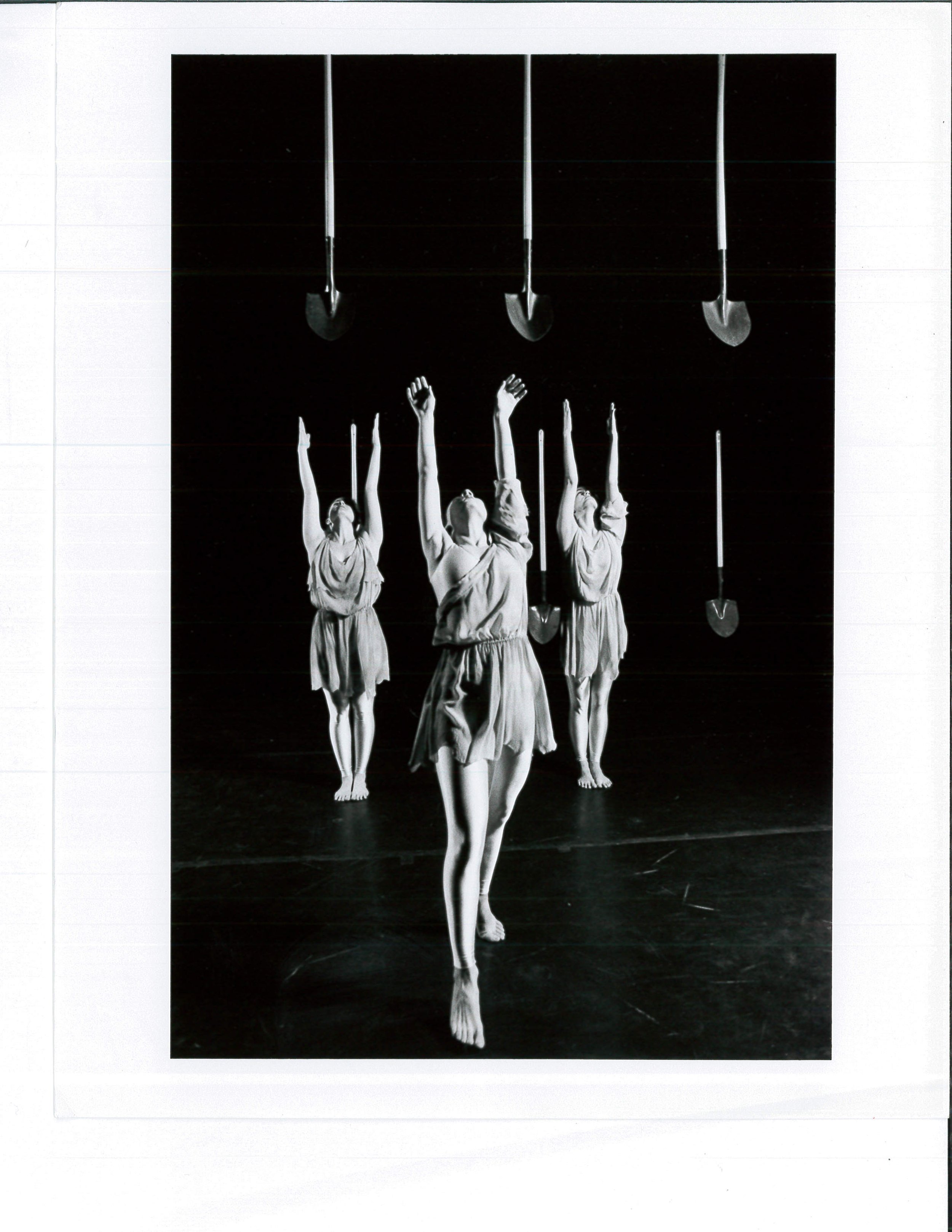
In Dig, I used the metaphor of an archaeological excavation as a vehicle for self-discovery. Set designer Peter Beudert had the inspired idea of suspending thirty evenly spaced shovels above the dancers’ heads, their points facing somewhat ominously downward. The shovels evoked a parapet on an ancient structure and created a simple, elegant, and striking visual environment.
Echoing the gradual discovery of fragments in an archaeological dig, the dance was divided into approximately twenty short scenes ranging from twenty seconds to two minutes in length, each separated by a brief blackout. David Borden’s score featured a soaring female soprano singing wordless melodies above contrapuntal synthesizer and bass clarinet lines. The music was performed live during the Power Center performances.
I do not have a video readily available as I write this, and more than thirty-five years have passed since I created the work. Nevertheless, many of its images remain vivid in my memory. The list of scene titles printed in the program has also helped reconstruct portions of the dance.
In the opening scene, “To the Quick,” dancers dressed in short Grecian tunics ran back and forth across the stage, pressing pottery shards against their breastbones in a kind of Dionysian reverie. The image was inspired by Margaret Mead’s film Trance and Dance in Bali, in which temple dancers ritually stab themselves with krises yet emerge unharmed. During this same scene, dancers crisscrossed the stage carrying different parts of a female statue—arms, legs, and head—represented by a dismembered mannequin prepared by the University Productions prop shop. Blackout.
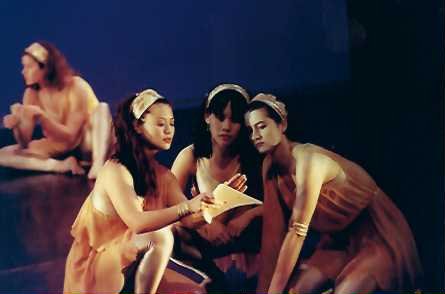
The next scene, “Archaeology,” likely featured dancers brushing away earth, uncovering pottery shards, and examining them closely.
In “Caryatids,” dancers stood evenly spaced like the sculpted maidens of the Erechtheion on the Acropolis. Shifting their weight from one hip to the other, they emphasized the contrapposto stance of the ancient figures. Ablackout followed.
I no longer recall what happened in “Pondering the Circle.” Perhaps one or more dancers circled a ring of pottery shards on the ground, studying them.
In Scene Five, “Signatures,” five dancers simultaneously performed solo choreography based on their first names. They created shapes with their bodies corresponding to individual letters and traced pathways through space that echoed the forms of those letters. These self-signatures allowed the dancers to contribute directly to the choreography while also serving as affirmations of identity.
“Finding” was likely a brief vignette in which another shard was uncovered with a brush and carefully examined.
I am less certain about the next two scenes, “Cutting Off” and “Prancing Vase.” My recollection is that “Prancing Vase” featured a buoyant prancing step, perhaps organized into the outline of a vase.
“Koroi/Isadoras” juxtaposed the rigid parallel fourth-position stance of archaic Greek koroi and korai with the free-flowing movement associated with Isadora Duncan. Some dancers performed stiff, plaster-like steps forward and backward, while others skipped, galloped, and leapt with Duncan-inspired freedom.
This scene was followed by a duet in which two additional dancers performed the signatures of their first names.
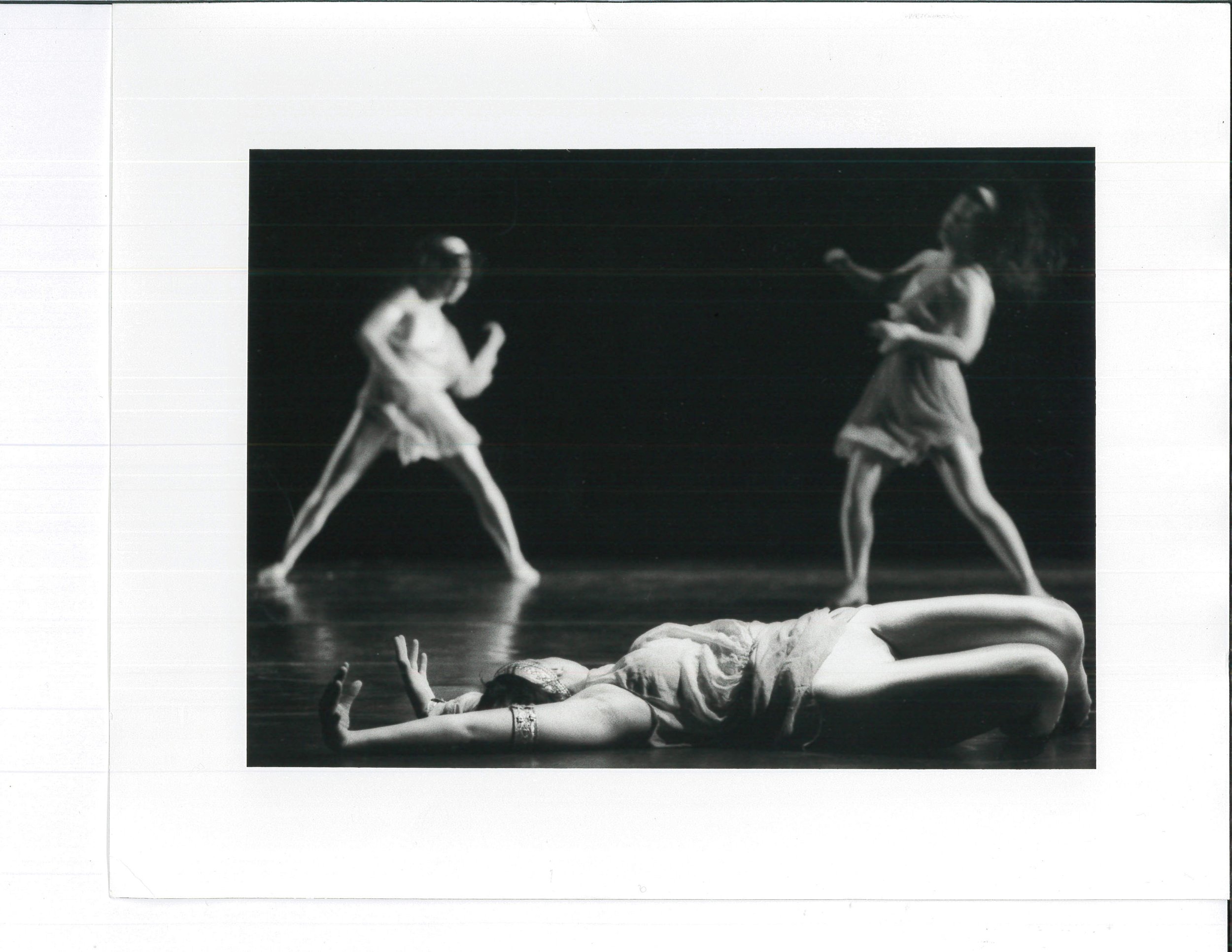
I do not recall the specifics of “Wind and Wrists.” In one of these middle sections—perhaps “Wind and Wrists,” perhaps “In Pieces”—the dancers flung their long hair wildly, moving their torsos in a state of ecstatic, Dionysian abandon. The “wrists” may refer to the drooping wrists I used in my solo Departures 1974. Or it may refer to a phrase on the ground with drooped wrists and slow rolling movement. One of the photos below provides that clue for me.
In “Line of Tears,” all of the dancers formed a diagonal from downstage right to upstage left and performed in unison a stylized gesture of wiping a tear from the eye, then unfolding the arm slowly and letting the tear fall from the fingertips to the ground.
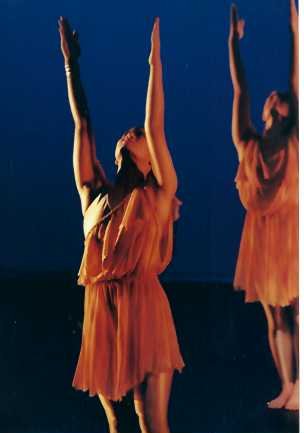
In “Six Columns,” six dancers stood in three upstage-to-downstage lines—three on each side—with arms raised like Greek columns. A seventh dancer, I believe Lisa Catrett-Belrose, repeatedly ran down the aisle formed by the columns, stopping at the downstage center edge of the stage and thrusting her hips forward and arms flung overhead as she arrived downstage before turning and running back upstage to begin again.
This was followed by another series of signatures, this time performed by four dancers.
In “Piecing Together,” the archaeologist-dancers gathered shards and tried to assemble them, gradually solving part of a larger puzzle.
Another “Prancing Vase” scene followed.
The later “Finding” may have involved the discovery of an entire statue. A dancer, lying stiffly on the ground on her back, was lifted upright by several dancers, as though excavated intact. She wore a Grecian tunic and black high heels. This role was performed on some evenings by Sarah Blackburn and on others by Cary McWilliams, as the work was double cast.
The erected statue then walked toward the downstage-right corner and proceeded across the front of the stage, slipping off first one high heel and then the other. In removing her shoes, she evoked the famous relief sculpture of Nike adjusting her sandal before entering the Temple of Athena.
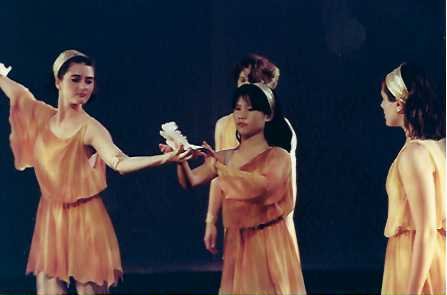
At this point another dancer, Rosa Huang, presented her with a bird. The statue dancer then held it aloft as an offering.
I had thought this was the conclusion of the dance, but the program indicates that two brief scenes followed.
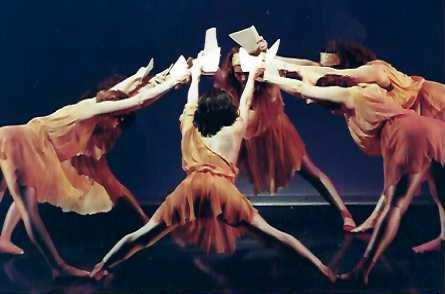
In one, the dancers each picked up a pottery shard and formed a tight circle, backs sharply angled outward and arms raised overhead holding shards, creating the shape of a vase.
In the final image, the dancers assembled in a line formation resembling the feathered wing of a bird. I believe they were line up just right of center stage.
The photographs below capture many of these moments. I see that in one scene the dancers are framing their motions with picture frames, but I don’t recall that well. These props may have been discarded in the final rehearsals after the photo shoot, but perhaps not.
In looking back, I remember Dig as a series of excavations—of artifacts, memories, identities and histories, gradually assembled into a portrait of self-discovery and celebrating a community of women.